
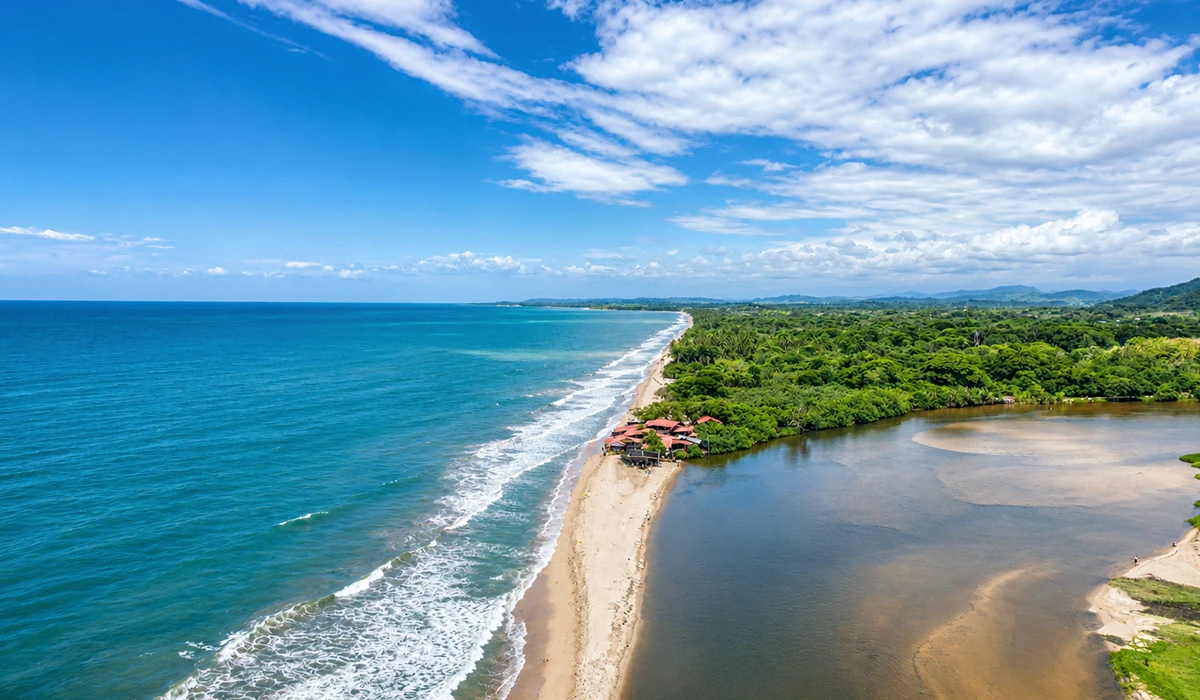
Palomino is a small beach town in La Guajira, Colombia, right on the border with the Magdalena department, where the Palomino River comes down from the Sierra Nevada de Santa Marta and flows into the Caribbean. It has about 2,500 residents, sits roughly 2 hours from Santa Marta along the Troncal del Caribe highway and has become one of the coast’s favorite stops: river tubing, long palm-lined beaches, beachfront hostels and the snow-capped Sierra Nevada as a backdrop on clear mornings. Here’s how to get there, what to do, what it costs in 2026 and how to combine it with Tayrona, the Lost City and the rest of La Guajira.
Updated on 20 November 2026. Transport and activity prices change with the season; sources and their dates are listed at the end.
Where is Palomino?
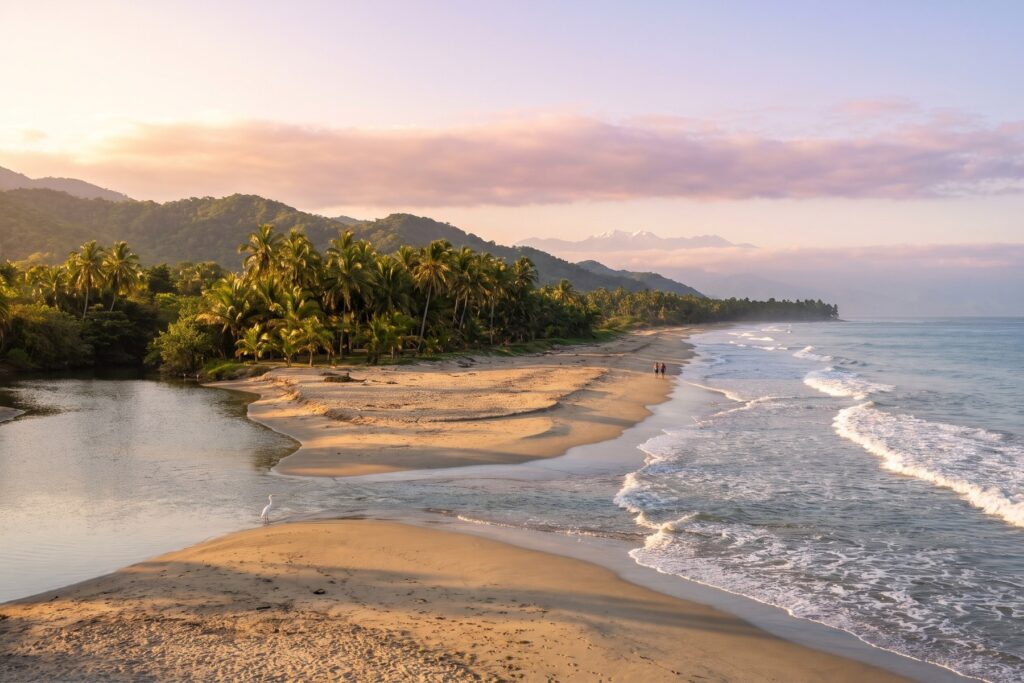
Palomino lies on the Troncal del Caribe, the highway linking Santa Marta and Riohacha, on the Guajira bank of the river it’s named after. Administratively it’s a village (corregimiento) of the municipality of Dibulla, so although people often search for “Palomino, Santa Marta”, it’s in La Guajira. Key distances:
- Santa Marta: about 80 km by road, around 2 hours by bus.
- Riohacha: about 90 km, 1 hour 20 to 1 hour 30 minutes.
- El Zaíno entrance to Tayrona National Park: about 45–50 km, roughly an hour.
- Guachaca, where the road to the Lost City trailhead begins: about 40 km.
How to get to Palomino
From Santa Marta
There are two types of bus, and the price gap is big:
- Local buses from the Public Market (Mercado Público): they leave from behind the market from early morning until 6:00 p.m., departing when full (you may wait up to half an hour). They cost about COP 14,000 and stop along the way.
- Coaches from the bus terminal (Brasilia, Unitransco and others): more comfortable, on a fixed schedule, for COP 29,500–32,000.
Either way the ride takes about 2 hours and drops you at the Palomino gas station on the highway. From there it’s a 15-minute walk to the beach or a COP 4,000–5,000 moto-taxi. Note that halfway there, at the Mendihuaca River, traffic has crossed a temporary military bridge since March 2026 after the old bridge collapsed, which sometimes causes short delays.
From Riohacha
Buses heading to Santa Marta drop you in Palomino in 1 hour 20 to 1 hour 30 minutes. Published 2026 fares range from COP 15,000–20,000 with the cheaper companies up to COP 44,000 with others.
From Cartagena and Barranquilla
Direct buses leave Cartagena’s terminal for COP 52,000–55,000 (5 to 6.5 hours). From Barranquilla it’s about 3.5 hours; published fares vary a lot between companies, so compare before you buy.
By air
The nearest airports are Santa Marta (Simón Bolívar, SMR) and Riohacha (Almirante Padilla, RCH). From either one, continue by bus or taxi along the highway.
Things to do in Palomino
Tubing down the Palomino River
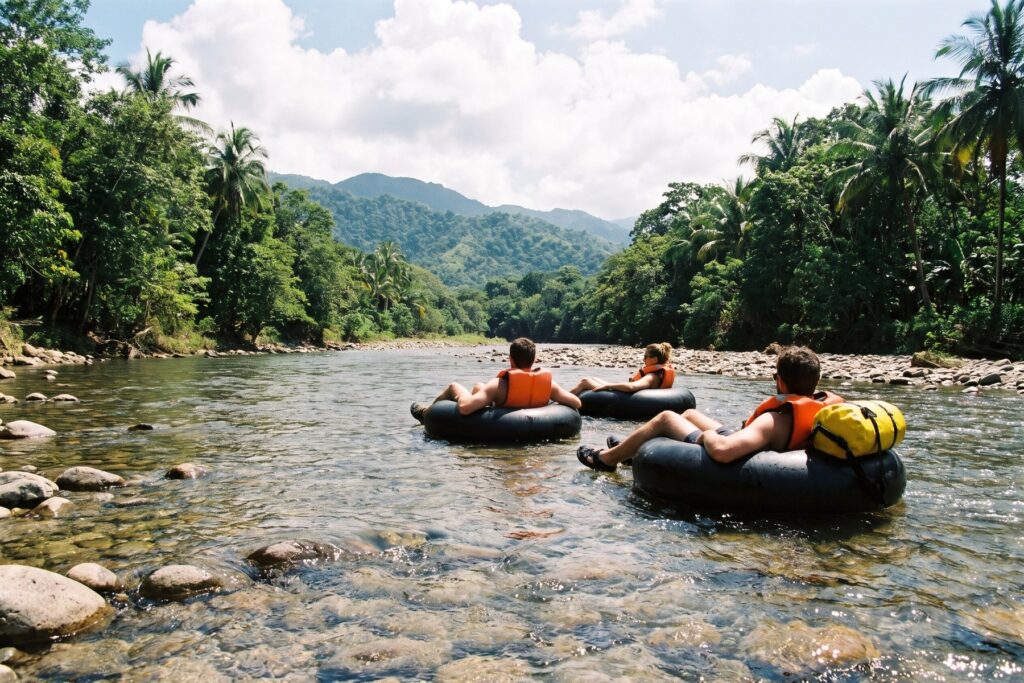
The signature activity: a moto-taxi takes you upriver, you get an inner tube and a life jacket, and you float back down through Sierra Nevada rainforest to where the river meets the sea. The river is calm and shallow for most of the way. In 2026 prices range from about COP 40,000 for the short route (around 2 hours) to COP 130,000–140,000 for the long route, which starts higher up, near Kogi territory. Always wear the life jacket, tell the guide if you can’t swim and skip it after heavy rain, when the river rises. In the driest months the water can get so low that the float becomes slow.
Palomino beach: beautiful, but a rough sea
The beaches are wide, with dark sand and palm trees, and perfect for sunset walks. But Palomino faces the open sea and has strong currents: several tourists have drowned in recent years, and we couldn’t confirm a permanent lifeguard service. If you go in, stay where big waves aren’t breaking, never swim alone, at night or after drinking, and respect red flags. Erosion has also eaten into the beach in some stretches.
Quebrada Valencia
About 30 minutes along the highway toward Santa Marta, plus a 20–30 minute walk, is a chain of cold-water pools and small waterfalls in the forest. It’s a great plan for a hot day; there’s a small entrance fee (reported amounts vary, so bring cash).
The Sierra Nevada and its peoples
Palomino sits at the foot of the lands of the Kogi, Wiwa, Arhuaco and Kankuamo peoples, for whom the Sierra Nevada is the “heart of the world”. Some organizations offer visits to communities, but many communities prefer not to receive tourists: if you go, do it only through initiatives the communities themselves have authorized, ask before taking photos and never enter their territory on your own. To learn more, read our guide to the indigenous peoples of the Sierra Nevada de Santa Marta.
Birds, yoga and surfing
The Sierra Nevada has more than 600 recorded bird species; around Palomino you’ll spot herons, kingfishers and parrots along the river, although the endemic species live higher up. The town also has yoga classes and, on good-wave days, beginner surf schools.
Where to stay in Palomino
Options range from backpacker hostels to boutique beachfront hotels. As a guide, in November 2026:
- Hostels: dorm beds from about USD 8–18 a night (more in high season).
- Mid-range hotels and cabins: around USD 80–130 a night for two.
- Boutique beachfront hotels: from about USD 160, and considerably more in December–January.
Beachfront places cost more; those near the highway are cheaper but noisier. In high season (December–January, Holy Week and June–July) book ahead.
Is Palomino safe?
Day to day, Palomino is a relaxed, very touristy town. The thing to watch is the road: in 2026 the Troncal del Caribe corridor between Santa Marta and Dibulla saw road blockades in June, an armed strike by the Autodefensas Conquistadoras de la Sierra Nevada in September (in Palomino things were back to normal on 24 September, with an army presence) and fighting near Guachaca in October that closed the highway for a few hours. Our advice: travel by day, check the news or ask your operator before long road trips, and leave a buffer day before flights. The UK Foreign Office doesn’t advise against travel to La Guajira or Magdalena (apart from the 5 km strip along the Venezuelan border). We cover it in detail, with dates and sources, in is Colombia safe to visit?
Health: Colombia’s Ministry of Health classifies every municipality in La Guajira, including Dibulla, as high risk for yellow fever. Get vaccinated at least 10 days before your trip and carry the certificate, on paper or digitally.
Palomino, Tayrona and the Lost City: how to combine them
Palomino sits between the Caribbean coast’s big highlights, which makes it a handy base:
- Tayrona National Park: the El Zaíno entrance is about an hour away. The park reopened on 3 November 2026 after its last closure of the year; in 2026 it closed from 1–15 February, 1–15 June and 19 October to 2 November, plus an extraordinary security closure in February. If you’d rather not deal with transport and tickets, our full-day Cabo San Juan tour in Tayrona Park leaves from Santa Marta. Before you go, check the Tayrona closure dates.
- The Lost City (Ciudad Perdida): the road to the trailhead starts on the highway near Guachaca, between Santa Marta and Palomino. Teyuna Archaeological Park reopened on 16 October 2026 after its annual closure. Our 4-day Lost City trek leaves Santa Marta every day at 8:00 a.m.; if you’re staying in Palomino, message us to arrange a meeting point. See also the Lost City’s annual closure.
- La Guajira: from Palomino you can continue to Riohacha, Mayapo Beach and the desert. Our Upper Guajira trips can start in Riohacha, Santa Marta or Palomino: the 2-day Cabo de la Vela tour, the 3-day Punta Gallinas tour and the 4-day La Guajira tour.
A route that works well: two or three nights in Palomino, a day in Tayrona, then four days in the Upper Guajira or the Lost City trek.
Best time to visit Palomino
The dry season runs from December to April: more sun, clear skies and Sierra Nevada views in the mornings. It rains more in May and, above all, from September to November; rain raises the river (better for tubing, but dangerous right after a downpour). For 2026–2027, Colombia’s weather agency IDEAM has declared a strong El Niño that may last until March 2027, so expect less rain and more heat than usual, and a lower river in the dry months. High season (December–January, Holy Week and June–July) brings more atmosphere and higher prices.
Palomino FAQ
Which department is Palomino in?
Palomino is in La Guajira. It’s a village of the municipality of Dibulla, right on the border with Magdalena, which is why people often associate it with Santa Marta.
How long does it take to get from Santa Marta to Palomino?
About 2 hours by bus along the Troncal del Caribe (around 80 km by road). By private car with no stops, 1.5 to 1.75 hours.
How much is the bus from Santa Marta to Palomino?
In 2026, about COP 14,000 on the local buses that leave from behind the Public Market, and COP 29,500–32,000 with the companies that leave from the bus terminal.
Can you swim at Palomino beach?
With great caution. The sea has strong currents, tourists have drowned and we couldn’t confirm a permanent lifeguard service. Only go in where big waves aren’t breaking, never alone or after drinking, and respect red flags.
How much does tubing in Palomino cost?
Depending on the route, COP 40,000 to 140,000 in 2026. It usually includes the moto-taxi upriver, the tube and a life jacket, and takes 1 to 3 hours.
How many days should I spend in Palomino?
Two or three nights are enough for tubing, the beach and Quebrada Valencia. Add one or two more if you want to visit Tayrona or continue into La Guajira.
Sources
- DANE, 2018 National Population and Housing Census (Palomino population, via Wikipedia, accessed 20 Nov 2026).
- Gecko Routes, “Santa Marta to Palomino” (updated 20 Aug 2026) and “Cartagena to Palomino” (1 Nov 2025): bus companies, schedules and fares.
- Pinbus, Santa Marta–Palomino and Riohacha–Palomino routes (fares checked 20 Nov 2026).
- Chipviajero, “Cómo llegar a Palomino” (updated 19 May 2026) and Aloha Palomino, 2026 tubing guide (July 2026): tubing prices.
- La República, military bridge over the Mendihuaca River opens (31 Mar 2026).
- El País (Colombia), report on drownings at Palomino (23 Jul 2023); Diario del Norte (19 Apr 2025).
- Hostelworld and Kayak, Palomino accommodation prices (checked 20 Nov 2026).
- Colombia’s National Natural Parks: Resolution 091 of 17 Feb 2026 (extraordinary closure), statement of 3 Jul 2026 and Resolution 551 of 2025 (2026 fees); Infobae, Tayrona reopening (3 Nov 2026).
- ICANH, reopening of Teyuna Archaeological Park on 16 Oct 2026 (statement of 9 Oct 2026).
- Guajira News, “Palomino vuelve a la normalidad” (24 Sep 2026); Semana, fighting in Guachaca (23 Oct 2026); El Espectador, blockades on the Troncal del Caribe (22 Jun 2026).
- UK Foreign, Commonwealth & Development Office, Colombia travel advice (updated 30 Oct 2026).
- Colombian Ministry of Health, External Circular 012 of 3 Apr 2025 (high-risk municipalities for yellow fever).
- IDEAM / Colombian Ministry of Environment, El Niño declaration (8 Oct 2026).
- Expotur, original guide “Guide to travel to Palomino” (published 9 Oct 2019; Internet Archive copy of 20 Jun 2025).